

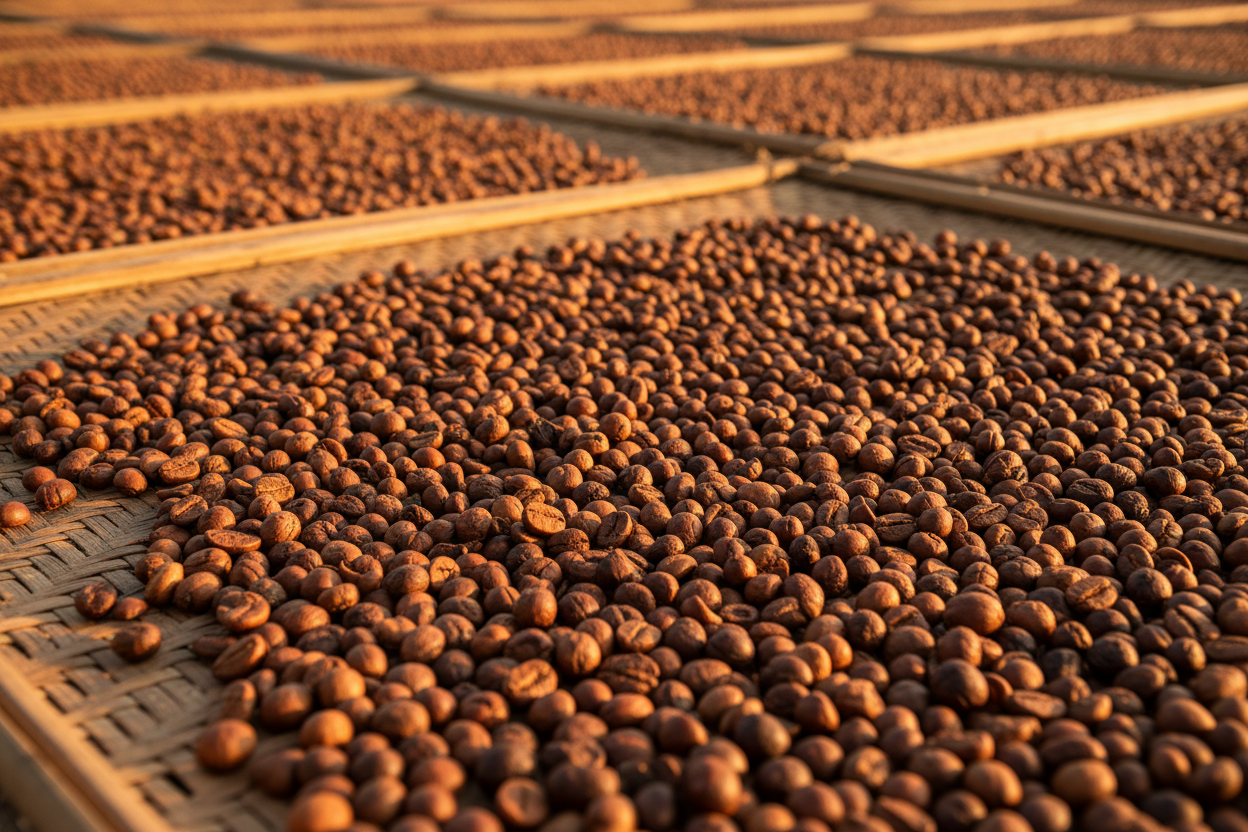
Coffee is everywhere. It's in your kitchen, your commute, your morning ritual, and your favorite local shop. It's one of the most traded commodities on the planet and the second most consumed beverage in the world after water. But most people have no idea where it came from, how it spread across the globe, or why the cup in your hand exists at all.
The history of coffee is a story about discovery, trade, religion, revolution, and the relentless human need to find something that helps us think a little clearer and push a little harder. That story starts in the highlands of East Africa and it's a lot more interesting than most people realize.
The Origin of Coffee: Ethiopia and the Legend of Kaldi
The history of coffee begins in Ethiopia, somewhere around the 9th century. The most well-known origin story involves a goat herder named Kaldi, who reportedly noticed his goats behaving strangely energetic, restless, refusing to sleep after eating red berries from a particular tree. Kaldi brought the berries to a local monastery, where monks brewed them into a drink and found it kept them alert through long hours of evening prayer.
Whether Kaldi was a real person is debated. What isn't debated is that the coffee plant Coffea arabica is native to the highlands of what is now Ethiopia, specifically the Kaffa region. Coffee cultivation and consumption in Ethiopia almost certainly predates any written record, with indigenous communities chewing the raw berries or mixing them with animal fat for energy long before anyone thought to brew them.
Ethiopia isn't just where coffee was discovered. It's where coffee lives. Wild coffee still grows in the Ethiopian highlands today, in biodiverse forests that represent the genetic origin of nearly all the coffee consumed in the world. That's not a marketing angle — it's botanical fact. When you drink an Ethiopian single origin, you're drinking from the oldest coffee lineage on earth.
The Coffee Trade Takes Root: Yemen and the Arab World
From Ethiopia, coffee crossed the Red Sea to Yemen, likely sometime in the 15th century. Sufi monks in Yemen began cultivating and consuming coffee as a tool for nighttime devotion — the same reason the Ethiopian monks had valued it. The port city of Mocha (yes, that Mocha) became the first major hub of the international coffee trade, and Yemen held a near-monopoly on global coffee cultivation for over a century.
Yemeni traders understood the value of what they had, and they protected it aggressively. Green coffee beans were boiled or partially roasted before export to prevent germination an early form of trade protection to ensure no one could grow their own. For a long time, it worked.
Coffee spread rapidly across the Arab world. By the early 16th century, coffeehouses called qahveh khaneh had appeared across Persia, Egypt, Syria, and the Ottoman Empire. These weren't just places to drink. They were social institutions. People gathered to play chess, exchange news, debate politics, and conduct business. They were called "Schools of the Wise" in some accounts. The coffeehouse as a concept a public space organized around the ritual of coffee was born in the Arab world centuries before it reached Europe.
This period also saw the first controversies around coffee. Religious authorities in Mecca banned it twice in the 1500s, viewing coffeehouses as centers of political dissent and social disruption. The Ottoman Sultan Murad IV eventually made selling coffee punishable by death. These bans never held for long. Coffee was too deeply embedded in daily life and too economically significant to suppress.
Coffee Reaches Europe: The 17th Century Explosion
Coffee arrived in Europe in the early 1600s, carried by Venetian traders from the Ottoman Empire. It met immediate resistance from the Catholic Church, whose leaders called it the "bitter invention of Satan" and petitioned Pope Clement VIII to ban it. According to legend, the Pope tasted it first and promptly gave it his blessing. Whatever the accuracy of that story, coffee was never seriously suppressed in Europe.
The coffeehouse culture that had flourished in the Arab world transplanted itself almost immediately into European cities. London's first coffeehouse opened in 1652. Within a decade there were hundreds. By the early 18th century, London alone had over 2,000 coffeehouses, and they had become the operating centers of intellectual and commercial life.
Lloyd's of London the insurance market started as a coffeehouse where merchants and sailors gathered to share shipping news. The London Stock Exchange grew out of Jonathan's Coffee House, where traders met to buy and sell shares. The concept of the newspaper was shaped by the culture of coffeehouses, where printed broadsides were posted and read aloud. These weren't just places to get a caffeine fix. They were where the modern world was being built.
In France, the Café de Procope opened in Paris in 1686 became a meeting place for Voltaire, Rousseau, and Diderot. The intellectual energy of the French Enlightenment was, at least in part, fueled by coffee. Some historians have only half-jokingly noted that the shift from ale-drinking mornings to coffee-drinking mornings in Europe coincided with a marked increase in intellectual productivity.
Coffee Cultivation Goes Global: Breaking Yemen's Monopoly
Yemen's stranglehold on the coffee trade finally broke in the late 17th century when a Muslim pilgrim named Baba Budan smuggled seven live coffee seeds out of Mecca and brought them to the hills of Karnataka in southern India. That act of botanical smuggling celebrated in India to this day cracked open the global coffee cultivation story.
From India, the Dutch obtained plants and began cultivating coffee in Ceylon (now Sri Lanka) and on the island of Java in present-day Indonesia. Java became so synonymous with coffee that the word itself became slang for the drink. The Dutch sent a plant to the Amsterdam Botanical Garden, which became the source of virtually all the coffee plants that would eventually reach the Americas.
A French naval officer named Gabriel de Clieu obtained a cutting from Amsterdam in 1720 and transported it to Martinique in the Caribbean a voyage during which, by his own account, he shared his personal water ration with the plant during a drought at sea. From that single plant, coffee cultivation spread across the Caribbean and into Central and South America with remarkable speed.
Brazil received its first coffee plants in 1727, through an equally dramatic episode involving a Portuguese officer and a gift from the wife of the French Governor of Guiana. Within a century, Brazil had become the dominant force in global coffee production a position it has never relinquished. Today Brazil produces roughly one-third of all the coffee in the world.
Coffee Cultivation and the Dark Side of the Trade
The rapid expansion of coffee cultivation across the Americas was inseparable from the Atlantic slave trade. Coffee plantations in Brazil, the Caribbean, and Central America were built and worked by enslaved people. The economic engine that made coffee a global commodity ran on forced labor a history that the coffee industry spent a long time ignoring and is only more recently beginning to reckon with honestly.
Brazil was the last country in the Western Hemisphere to abolish slavery, in 1888 and its coffee economy was a major reason for the delay. The relationship between coffee and exploitative labor didn't end with abolition. Throughout the 19th and 20th centuries, coffee-growing regions from Guatemala to the Congo were shaped by colonial land grabs, debt peonage, and economic systems designed to keep the people doing the hardest work growing and harvesting at the bottom of the value chain.
This history matters today because it's not entirely history. The same structural inequities that made colonial coffee profitable still shape global coffee economics. Most coffee farmers earn a fraction of what their crop sells for by the time it reaches a consumer in North America or Europe. The specialty coffee movement with its emphasis on direct trade, fair prices, and traceability is, among other things, a response to this legacy.
The Three Waves of Coffee Culture
Coffee history didn't stop at the colonial era. The 20th century brought its own revolutions.
The First Wave was about access. Maxwell House, Folgers, and instant coffee brought coffee into every American home after World War II. Quality was secondary to convenience and consistency. Coffee became a daily habit for millions but it was largely undifferentiated, commodity-grade, and brewed badly.
The Second Wave was about experience. Starbucks and the café culture it popularized in the 1980s and 1990s introduced Americans to espresso drinks, origin-labeled coffees, and the idea that coffee was something worth savoring. It created coffee culture as a lifestyle concept. The tradeoff was standardization the same dark roast profile, the same drink menu, the same experience in every city.
The Third Wave — where specialty coffee lives today is about craft, origin, and transparency. Third-wave roasters treat coffee the way fine winemakers treat grapes: as an agricultural product whose quality is defined by where it was grown, how it was processed, and how it was roasted. Single-origin coffees, microlots, natural processing methods, light roast profiles, and direct relationships with farmers are the hallmarks of this era.
We are deep into the third wave, and it has permanently raised the standard for what coffee can be.
Why This History Lives in Your Cup
Every bag of single-origin specialty coffee is connected to this story. The Ethiopian highlands where coffee was born are still producing some of the most extraordinary coffees in the world. Honduras where our Chief Hutch single origin comes from sits in the heart of the "Bean Belt," the equatorial zone where climate and altitude produce the conditions for great coffee cultivation. The farmers growing that coffee are the modern heirs of a tradition stretching back centuries.
When you choose specialty coffee over commodity coffee, you're not just choosing better flavor. You're participating in a correction supporting a supply chain that pays farmers fairly, values quality over volume, and treats coffee cultivation as something worth doing well.
That's always been what coffee deserved. It just took a few centuries to get there.
Share and get 15% off!
Simply share this product on one of the following social networks and you will unlock 15% off!